1800 Gross to Net Salary Calculator: Monthly & Annual Take‑Home Pay (2026)
You see $1,800 on your job offer or pay stub. That’s your gross monthly salary. But what actually lands in your bank account after taxes, Social Security, and Medicare?
If you earn $1,800 per month gross, your net (take‑home) pay will be lower – sometimes significantly, depending on where you live.
In this guide, we’ll:
- Show you exactly how to calculate net from $1,800 gross
- Break down annual, biweekly, and weekly equivalents
- Provide a live calculator that adjusts for your tax rate
- Give you a realistic monthly budget based on net income
No more surprises on payday.
💰 $1,800 Gross to Net Salary Calculator
See your monthly, annual & weekly take‑home pay after taxes
How Much Is $1,800 Gross Monthly? (Quick Answer)
Annual gross salary = $1,800 × 12 = $21,600 per year
But after typical taxes (federal income tax + Social Security + Medicare + average state tax ≈ 14.5% for this income level):
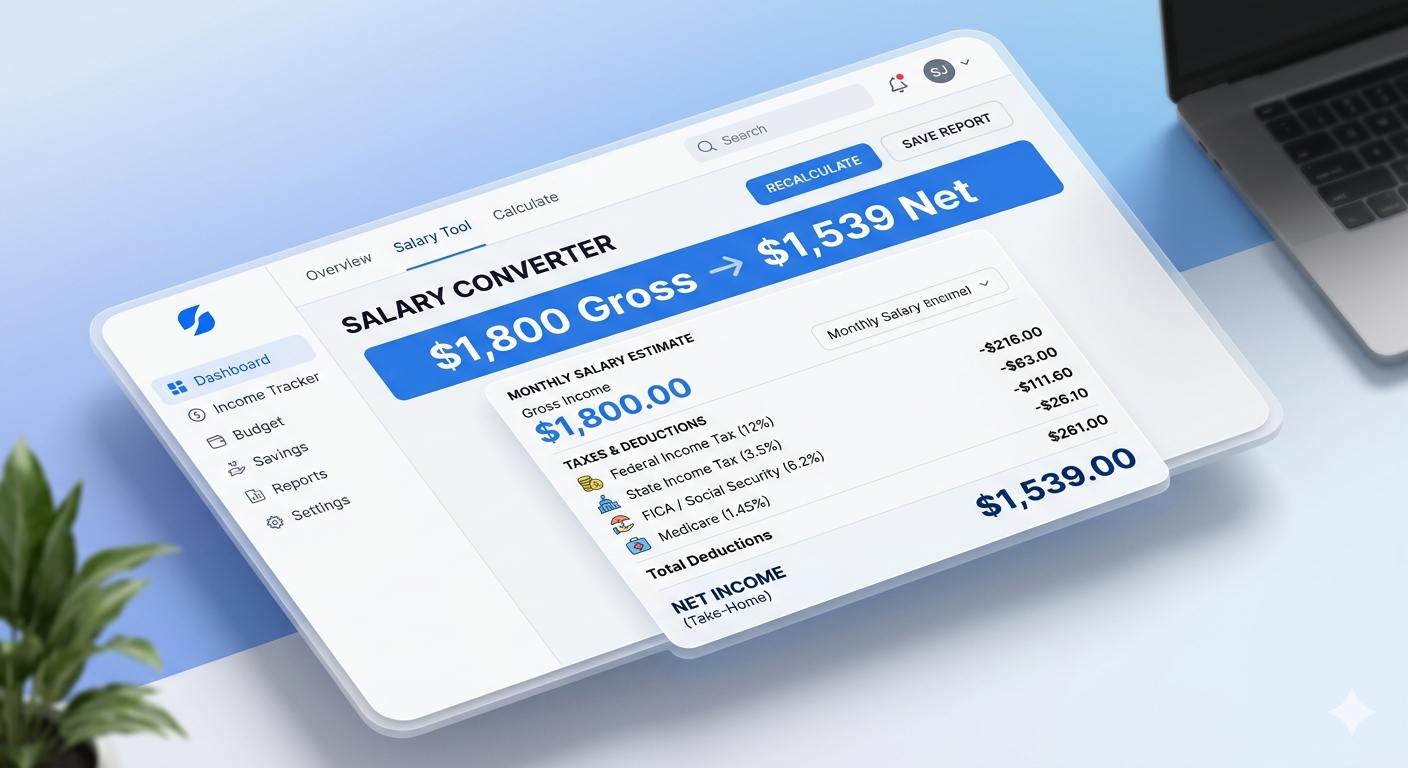
- Monthly net ≈ $1,539
- Annual net ≈ $18,468
- Biweekly net ≈ $710
- Weekly net ≈ $355
⚠️ These are estimates. Your actual net depends on your filing status, state, and deductions. Use the calculator below for a personalized result.
How the 1800 Gross to Net Calculator Works
Our tool uses standard IRS withholding logic:
- Annual gross = Monthly gross × 12 (or weekly × 52, etc.)
- Total taxes = Annual gross × (your tax rate / 100)
- Annual net = Annual gross – Total taxes
- Monthly net = Annual net ÷ 12
- Biweekly net = Annual net ÷ 26
- Weekly net = Annual net ÷ 52
The default tax rate of 14.5% includes:
- Federal income tax (10% bracket for ~$21k)
- Social Security (6.2%)
- Medicare (1.45%)
- Average state income tax (~3‑5%, reduced for low income)
You can adjust the tax rate up or down to match your state (0% in TX/FL, ~8‑10% in CA/NY).
Why Convert Gross to Net
✅ Create a realistic budget – You can’t spend gross income.
✅ Avoid debt – Knowing your net prevents overspending.
✅ Compare job offers – A $1,900 gross job in a high‑tax state might pay less net than $1,800 in a no‑tax state.
✅ Plan for taxes – If you’re self‑employed, your net will be even lower (self‑employment tax ~15.3%).
✅ Set savings goals – “Save 20% of net” is actionable.
Real‑World Examples: $1,800 Gross Monthly at Different Tax Rates
| Tax Rate | Monthly Net | Annual Net | Biweekly Net | Weekly Net |
|---|---|---|---|---|
| 10% (very low) | $1,620 | $19,440 | $748 | $374 |
| 14.5% (average) | $1,539 | $18,468 | $710 | $355 |
| 18% (high state tax) | $1,476 | $17,712 | $681 | $340 |
| 22% (self‑employed est.) | $1,404 | $16,848 | $648 | $324 |
👉 Self‑employed? Add ~7.65% extra for the employer portion of FICA. A typical self‑employed tax rate on $21k is around 20‑22%.
Step‑by‑Step: How to Use the Interactive Calculator
- Enter your gross monthly income – Default is $1,800. Change if your salary is different.
- Enter your tax rate (%) – Start with 14.5% for a single filer with no state tax.
- If you live in California, try 18‑20%.
- If you live in Texas or Florida, try 10‑12% (federal only).
- Click “Calculate Net Pay” – See your annual, monthly, biweekly, weekly, and after‑tax results instantly.
- Adjust the tax rate – See how much Uncle Sam really takes.
💡 Pro tip: For the most accurate result, check your last pay stub. Divide the “total deductions” by your gross pay to find your personal tax rate.
$1,800 Gross Monthly vs. Minimum Wage
Federal minimum wage is $7.25/hour. At 40 hours/week, that’s $1,256 gross monthly ($15,080/year).
So $1,800 gross monthly is about 43% higher than full‑time minimum wage.
However, many states have higher minimum wages:
- California: $16/hour → $2,773/month gross
- New York: $15/hour → $2,600/month gross
In those states, $1,800 gross is below full‑time minimum wage. Always check your local laws.
After‑Tax Breakdown for $1,800 Gross Monthly (14.5% Tax)
| Period | Gross | Taxes (14.5%) | Net |
|---|---|---|---|
| Monthly | $1,800.00 | $261.00 | $1,539.00 |
| Annual | $21,600.00 | $3,132.00 | $18,468.00 |
| Biweekly (26 periods) | $830.77 | $120.46 | $710.31 |
| Weekly (52 weeks) | $415.38 | $60.23 | $355.15 |
📌 Why biweekly? Many employers pay every two weeks. Your biweekly gross is $21,600 ÷ 26 = $830.77.
Monthly Budget Example: Living on $1,539 Net (Single Person, Low Cost Area)
| Category | % of Net | Amount |
|---|---|---|
| Rent (shared apartment) | 40% | $616 |
| Utilities & internet | 8% | $123 |
| Groceries | 15% | $231 |
| Transportation (bus/gas) | 10% | $154 |
| Health insurance (subsidized) | 5% | $77 |
| Savings (emergency fund) | 10% | $154 |
| Debt payment (minimum) | 7% | $108 |
| Personal & entertainment | 5% | $77 |
Total = $1,540 (rounded). This is a tight but possible budget in low‑cost states like Ohio, Indiana, or Arkansas.
If you live in a high‑cost city (NYC, SF, LA), you’ll likely need roommates or a second income.
Frequently Asked Questions (FAQ)
How much is $1,800 gross monthly after taxes?
After a typical 14.5% tax rate, your monthly net is approximately $1,539. Use the calculator above to adjust for your specific situation.
What is $1,800 gross annually?
$1,800 per month gross equals $21,600 per year before taxes. After 14.5% taxes, annual net is about $18,468.
How much is $1,800 gross biweekly?
If you’re paid every two weeks, your gross biweekly paycheck is $21,600 ÷ 26 = $830.77. After 14.5% taxes, biweekly net is about $710.
Is $1,800 a month a good salary?
It depends on your location and lifestyle. For a single person in a low‑cost area, it’s livable (rent ~$600‑$800). For a family or in a major city, it’s very difficult. Most financial experts recommend spending no more than 30% of gross on rent – for $1,800 gross, that’s $540/month, which is hard to find in many places.
How do I calculate net from gross myself?
Annual gross × (1 – tax rate) ÷ 12 = monthly net. Example: $21,600 × 0.855 = $18,468 annual net, divided by 12 = $1,539 monthly net.
What if I’m self‑employed earning $1,800/month gross?
Self‑employed people pay both the employee and employer portion of Social Security/Medicare (15.3% total) plus income tax. Your effective tax rate may be 20‑22%. Monthly net would drop to ~$1,400‑$1,440.
Conclusion: Know Your True Take‑Home Pay
Understanding the difference between $1,800 gross and your actual net income is the foundation of smart personal finance. Whether you’re budgeting for rent, saving for a car, or comparing job offers, always look at the net number – not the gross.
✅ Use the calculator below every time your salary or tax situation changes.
✅ Bookmark this page – you’ll come back when you get a raise or move to a different state.
✅ Share with a coworker – many people overestimate their take‑home pay.