How Much Tax Do I Pay on a $40,000 Salary? (2025/2026 Take-Home Guide)
You’ve got a job offer or a raise to $40,000 per year. Congratulations. But before you start planning how to spend it, you need to know what’s actually going to land in your bank account after taxes.
If you’re asking, “How much tax do I pay on a $40,000 salary?” — you’re not alone. It’s one of the most common questions for early‑career professionals, freelancers, and anyone entering the middle‑income bracket.
In this guide, we’ll break down exactly how much you’ll owe in:
- Federal income tax
- Social Security and Medicare (FICA)
- State income tax (with real examples from different states)
Plus, you’ll get an interactive calculator to estimate your own take‑home pay in seconds. No complicated tax forms. No guesswork.
💰 Tax on $40,000 Salary Calculator
Estimate federal, FICA & state taxes — see your real take‑home pay
Quick Answer: How Much Tax on $40,000?
For a single filer in 2025 with no special deductions, here’s the estimated tax breakdown:
| Tax Type | Amount |
|---|---|
| Federal income tax | ~$3,074 |
| Social Security (6.2%) | $2,480 |
| Medicare (1.45%) | $580 |
| Total federal taxes | ~$6,134 |
That leaves you with approximately $33,866 after federal taxes only.
But wait: Most people also pay state income tax. Depending on where you live, your total tax bill could be higher — or much lower.
📍 No state income tax? If you live in Texas, Florida, or one of the other no‑tax states, your take‑home could be as high as $35,432 per year (see the state breakdown below).
How Federal Income Tax Works on a $40,000 Salary
The U.S. uses a progressive tax system. That means you don’t pay a flat percentage on your entire income. Instead, your income is divided into chunks (brackets), and each chunk is taxed at a different rate.
For a single filer in 2025, the tax brackets are:
| Tax Rate | Taxable Income From | To |
|---|---|---|
| 10% | $0 | $11,925 |
| 12% | $11,926 | $48,475 |
| 22% | $48,476 | $103,350 |
Your $40,000 salary doesn’t all get taxed at 12%. Let’s do the math.
Step 1: Calculate Your Taxable Income
First, subtract the standard deduction. For 2025, the standard deduction for a single filer is $15,750. (For 2026, it rises to $16,100.)
Taxable income = $40,000 – $15,750 = $24,250Step 2: Apply the Tax Brackets
Now apply the brackets to your taxable income of $24,250:
- First $11,925 → taxed at 10% = $1,192.50
- Remaining $12,325 ($24,250 – $11,925) → taxed at 12% = $1,479
Total federal income tax = $1,192.50 + $1,479 = $2,671.50
That’s your federal income tax before any credits or deductions.
What About FICA? (Social Security & Medicare)
You also pay FICA taxes — that’s Social Security and Medicare. These are flat percentages taken from every paycheck.
| Tax | Rate | On $40,000 |
|---|---|---|
| Social Security | 6.2% | $2,480 |
| Medicare | 1.45% | $580 |
| Total FICA | 7.65% | $3,060 |
⚠️ Important: Your employer pays another 7.65% on your behalf. That’s why your total compensation is higher than your salary.
Total Federal Taxes on $40,000 (2025)
| Tax Component | Amount |
|---|---|
| Federal income tax | $2,672 |
| Social Security | $2,480 |
| Medicare | $580 |
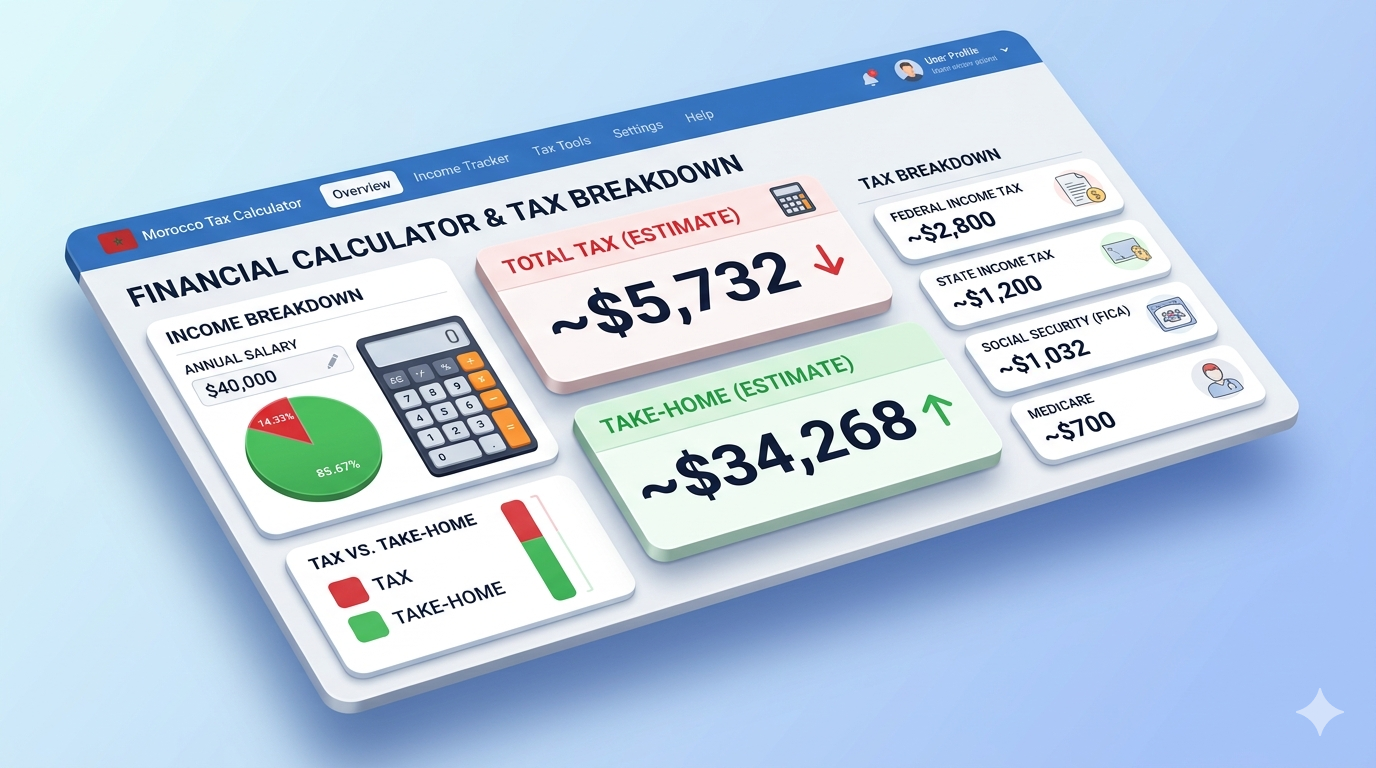
| Total federal tax | $5,732 |
Your federal take‑home pay = $40,000 – $5,732 = $34,268
💡 But wait — isn’t that different from the quick answer above? Yes. The quick answer used a simplified average tax rate. This step‑by‑step calculation is more accurate. Your actual federal take‑home is about $34,268.
State Income Tax: Where You Live Matters A Lot
This is where things get interesting. State income tax can add anywhere from 0% to over 10% to your tax bill.
States With No Income Tax (2025)
Nine states charge zero personal income tax:
- Alaska
- Florida
- Nevada
- New Hampshire
- South Dakota
- Tennessee
- Texas
- Washington
- Wyoming
If you live in one of these states, your take‑home pay is simply your federal after‑tax amount: about $34,268.
California: High Tax Example
If you earn $40,000 in California as a single filer, you’ll pay approximately $782 in state income tax (based on Forbes Advisor calculations). Your total tax bill rises to about $6,514, leaving you with roughly $33,486 after all taxes.
New York: Medium Tax Example
New York’s state tax rates for 2025 range from 4% to 5.85% for most middle incomes. At $40,000, you’d pay roughly $500‑$700 in state income tax, depending on your exact deductions.
Comparison Table: Take‑Home Pay by State
| State | State Tax (approx.) | Total Tax (Federal + State + FICA) | Estimated Take‑Home |
|---|---|---|---|
| Texas (no state tax) | $0 | $5,732 | $34,268 |
| Florida (no state tax) | $0 | $5,732 | $34,268 |
| California | $782 | $6,514 | $33,486 |
| New York | ~$600 | $6,332 | $33,668 |
| Illinois (flat 4.95%) | ~$1,200 | $6,932 | $33,068 |
2026 Tax Changes: What You Need to Know
The IRS adjusts tax brackets and the standard deduction for inflation each year. For 2026, here are the key changes:
- Standard deduction for single filers: Increases to $16,100
- 10% bracket: Applies to income up to $12,400
- 12% bracket: Applies to income from $12,401 to $59,550
What does this mean for a $40,000 salary in 2026?
- Taxable income = $40,000 – $16,100 = $23,900
- Tax = ($12,400 × 10%) + ($11,500 × 12%) = $1,240 + $1,380 = $2,620
- That’s about $50 less in federal income tax than in 2025.
✅ Bottom line: Inflation adjustments mean you’ll pay slightly less tax in 2026 on the same $40,000 salary.
How to Lower Your Taxes on a $40,000 Salary
You’re not stuck paying the full amount. Here are legitimate ways to reduce your tax bill:
- Contribute to a 401(k): Every dollar you put into a traditional 401(k) reduces your taxable income.
- Contribute to a traditional IRA: Same idea — up to $7,000 in 2025.
- Take the Earned Income Tax Credit (EITC): Single filers with no children earning under $18,591 may qualify, but at $40,000, you’re above the threshold. Check the IRS website for current limits.
- Use a Health Savings Account (HSA): If you have a high‑deductible health plan, HSA contributions are tax‑deductible.
Frequently Asked Questions (FAQ)
Below are the most common questions about taxes on a $40,000 salary.
Scroll down for the schema‑ready JSON‑LD to help Google feature these answers.
How much federal tax do I pay on $40,000?
For a single filer in 2025, federal income tax is approximately $2,672 after the standard deduction of $15,750. Add Social Security ($2,480) and Medicare ($580), and total federal taxes are about $5,732.
What is my take‑home pay after taxes on $40,000?
After federal income tax, Social Security, and Medicare, your take‑home is about $34,268. If you live in a state with income tax, subtract another $500‑$1,200.
Is $40,000 a good salary after taxes?
It depends on where you live. In low‑cost areas like rural Texas or Ohio, $34,000 take‑home is comfortable for a single person. In high‑cost cities like San Francisco or New York, it’s tight — you’ll likely need roommates or a second income.
How much tax do I pay on $40,000 in California?
In California, you’ll pay about $5,732 in federal taxes plus roughly $782 in state taxes, for a total of about $6,514. Your take‑home would be approximately $33,486.
How much tax do I pay on $40,000 in Texas?
Texas has no state income tax, so your total tax is just the federal portion: about $5,732. Your take‑home is approximately $34,268.
What is the tax rate on $40,000?
Your effective tax rate (total tax divided by gross income) is about 14.3% (federal + FICA). Your marginal tax rate (the rate on your next dollar of income) is 12%.
How do I calculate my taxable income?
Gross income minus the standard deduction (or itemized deductions). For 2025, the standard deduction for a single filer is $15,750, so taxable income = $24,250.
Conclusion: Know Your Real Take‑Home Pay
A $40,000 salary sounds great on paper. But after federal income tax, Social Security, Medicare, and possibly state tax, your actual take‑home is closer to $33,000‑$34,000.
Knowing this number is essential for budgeting, saving, and making financial decisions. Don’t plan your life around your gross salary — plan around your net.
✅ Use the calculator below to see your exact take‑home based on your state.
✅ Bookmark this page — tax laws change every year, and we keep this updated.
✅ Share with a friend — most people overestimate their after‑tax income.

Wish you happiness
Every day is a new beginning
Hahahaha You are so good
Good a blog toper
i need more backlink i not get traffic
Here you are
i want if i will creat website prno i can make money
Great post,Thanks for sharing