39 Hours Per Week Salary: Calculate Monthly & Annual Earnings (Any Hourly Rate)
Not everyone works the traditional 40‑hour week. Many professionals, part‑time workers, and even some full‑time employees clock 39 hours per week – whether due to an unpaid lunch break, a compressed schedule, or company policy.
But how do you calculate your monthly and annual earnings from a 39‑hour workweek?
And what about taxes?
In this guide, we’ll break down exactly how to compute your salary at 39 hours/week, including:
- Gross annual, monthly, biweekly, and weekly pay
- Realistic after‑tax take‑home estimates
- Comparison with a standard 40‑hour week
- How to budget with a non‑standard schedule
Plus, use our interactive 39‑hour salary calculator below. Just enter your hourly rate, and get instant results.
📊 39 Hours Per Week Salary
Calculate monthly, annual & after‑tax earnings for any hourly wage
What Does “39 Hours Per Week” Mean for Your Pay?
If you’re paid by the hour, your total earnings depend on three things:
- Hourly wage
- Hours per week (here: 39)
- Weeks worked per year (typically 52, or 50 with unpaid vacation)
Basic formula:Annual salary = Hourly wage × 39 hours × Weeks per year
For example, at $15/hour:
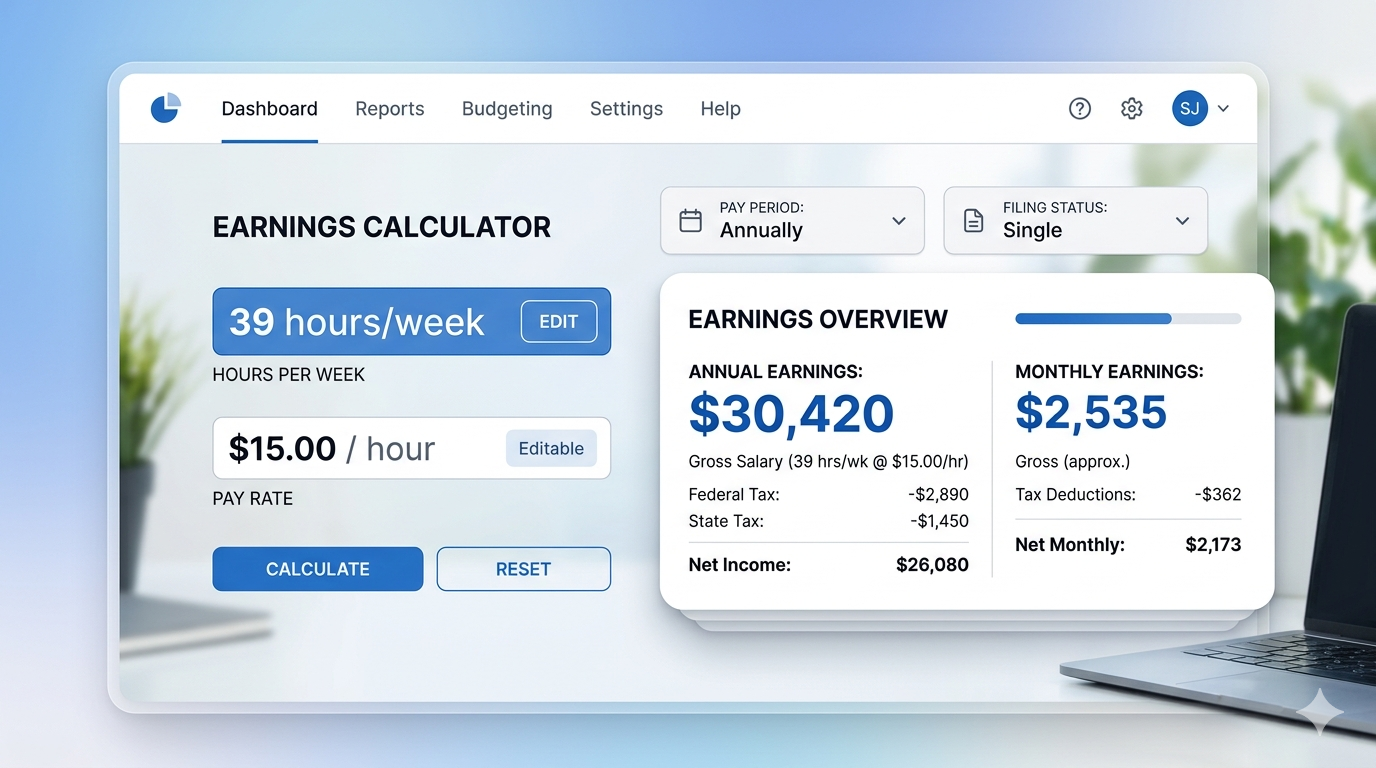
- $15 × 39 × 52 = $30,420 per year (gross)
- Monthly gross = $30,420 ÷ 12 = $2,535
At $20/hour:
- $20 × 39 × 52 = $40,560 per year
- Monthly = $3,380
💡 Key takeaway: 39 hours is just one hour less than the standard full‑time week. Over a year, that one hour per week costs you about 2.5% of your gross income compared to 40 hours
How the 39‑Hour Salary Calculator Works
Our tool (see below) follows standard payroll math:
- Annual gross = Hourly wage × 39 × weeks/year
- Monthly gross = Annual ÷ 12
- Biweekly gross = Annual ÷ 26
- Weekly gross = Annual ÷ 52
- After‑tax income = Gross × (1 – tax rate / 100)
We include a default tax rate of 14.5% for single filers earning ~$30k‑$40k (federal income tax + FICA + average state). But you can adjust it to match your state.
Why 39 hours matters:
Many employers define full‑time as 35‑40 hours. A 39‑hour week is still eligible for benefits at many companies (health insurance, 401k), but your paycheck will be slightly lower than a 40‑hour counterpart.
Benefits of Knowing Your Exact 39‑Hour Salary
✅ Compare job offers accurately – A $18/hour job at 40 hours might pay more than $19/hour at 39 hours.
✅ Budget for irregular schedules – If you consistently work 39 hours, plan monthly expenses precisely.
✅ Negotiate effectively – Ask for a small hourly bump to compensate for the missing hour.
✅ Estimate tax refunds – Use after‑tax numbers to avoid underpayment penalties.
Real‑World Examples: Different Hourly Rates at 39 Hours/Week
All figures below are gross (before taxes). Use the calculator for after‑tax numbers.
| Hourly Wage | Annual (52 weeks) | Monthly | Biweekly | Weekly |
|---|---|---|---|---|
| $12.00 | $24,336 | $2,028 | $936 | $468 |
| $15.00 | $30,420 | $2,535 | $1,170 | $585 |
| $18.00 | $36,504 | $3,042 | $1,404 | $702 |
| $20.00 | $40,560 | $3,380 | $1,560 | $780 |
| $22.00 | $44,616 | $3,718 | $1,716 | $858 |
| $25.00 | $50,700 | $4,225 | $1,950 | $975 |
👉 Pro tip: If you work 50 weeks per year (two weeks unpaid vacation), multiply annual figures by 50/52 ≈ 0.962. For $15/hour: $30,420 × 0.962 = $29,264.
39 Hours vs. 40 Hours: The Real Difference
Let’s compare a 39‑hour week vs. a 40‑hour week at the same $15/hour rate:
| Metric | 39 Hours/Week | 40 Hours/Week | Difference |
|---|---|---|---|
| Weekly gross | $585 | $600 | –$15 |
| Monthly gross | $2,535 | $2,600 | –$65 |
| Annual gross | $30,420 | $31,200 | –$780 |
That missing hour per week costs $780 per year – enough for a flight, several car payments, or a new laptop.
If you’re offered a 39‑hour role at $15.50/hour:
$15.50 × 39 × 52 = $31,434 → actually higher than $15/hour at 40 hours ($31,200).
So always do the math!
Step‑by‑Step: How to Use the Interactive Calculator
- Enter your hourly wage – Start with your actual rate (e.g., $17.50).
- Weeks per year – Default is 52. Change to 50 if you take two weeks unpaid leave.
- Tax rate (%) – Begin with 14.5% for single filers. Increase to 18‑22% if you’re in a high‑tax state or have additional income.
- Click “Calculate Your 39‑Hour Salary” – See annual, monthly, biweekly, weekly, and after‑tax earnings instantly.
- Experiment with different tax rates to understand your net pay.
🔍 Example: $18/hour, 39 hours/week, 52 weeks, 15% tax →
Annual net = $36,504 × 0.85 = $31,028
Monthly net = $2,586
After‑Tax Take‑Home Pay for 39 Hours/Week
Using a 14.5% effective tax rate (typical for $30k‑$40k income):
| Hourly Rate | Annual Gross | Annual Take‑Home | Monthly Take‑Home |
|---|---|---|---|
| $15.00 | $30,420 | $26,009 | $2,167 |
| $18.00 | $36,504 | $31,211 | $2,601 |
| $20.00 | $40,560 | $34,679 | $2,890 |
| $22.00 | $44,616 | $38,147 | $3,179 |
If you live in no‑income‑tax states (TX, FL, WA, TN, etc.), your take‑home could be $800‑$1,200 higher per year.
Monthly Budget Example: $18/hour at 39 Hours/Week ($2,601 take‑home)
| Expense Category | % of Net | Amount |
|---|---|---|
| Rent + utilities | 35% | $910 |
| Groceries | 12% | $312 |
| Transportation | 10% | $260 |
| Health insurance | 8% | $208 |
| Savings | 10% | $260 |
| Debt payments | 10% | $260 |
| Entertainment / dining | 15% | $391 |
Total = $2,601 – a balanced, realistic budget.
Frequently Asked Questions (FAQ)
Below are the most common questions about a 39‑hour workweek salary.
Scroll further for the schema‑ready JSON‑LD to help Google feature these answers.
How do I calculate my annual salary if I work 39 hours per week?
Multiply your hourly wage by 39, then multiply by the number of weeks you work per year (usually 52). Example: $20 × 39 × 52 = $40,560.
Is 39 hours considered full‑time?
In most U.S. companies, full‑time starts at 30‑35 hours per week. 39 hours is typically full‑time, meaning you may qualify for benefits like health insurance and paid time off.
How much is 39 hours a week monthly after taxes?
At $15/hour and 14.5% tax, monthly take‑home is about $2,167. Use our calculator for your exact rate.
What’s the difference between 39 and 40 hours per week over a year?
At $15/hour, 39 hours gives you $780 less per year before taxes. That’s about $65 less per month.
Can I earn overtime at 39 hours?
Overtime (1.5× pay) typically starts after 40 hours in a workweek. If you work 39 regular hours, you wouldn’t earn overtime unless you exceed 40. Some states have daily overtime rules – check local laws.
What jobs commonly offer 39‑hour weeks?
- Retail management (salaried but tracked hourly)
- Customer support centers
- Hospital administrative staff
- Some union trade positions
- Part‑time professional roles (e.g., accounting, marketing)
Conclusion: Master Your 39‑Hour Paycheck
A 39‑hour workweek is more common than you think. Knowing exactly how to calculate your monthly, annual, and after‑tax earnings puts you in control of your finances – whether you’re budgeting rent, saving for a goal, or comparing job offers.
✅ Use the calculator below every time your hourly rate changes.
✅ Bookmark this page – you’ll return when you get a raise or move to a new state.
✅ Share with a colleague – many people don’t realize the impact of that one missing hour.