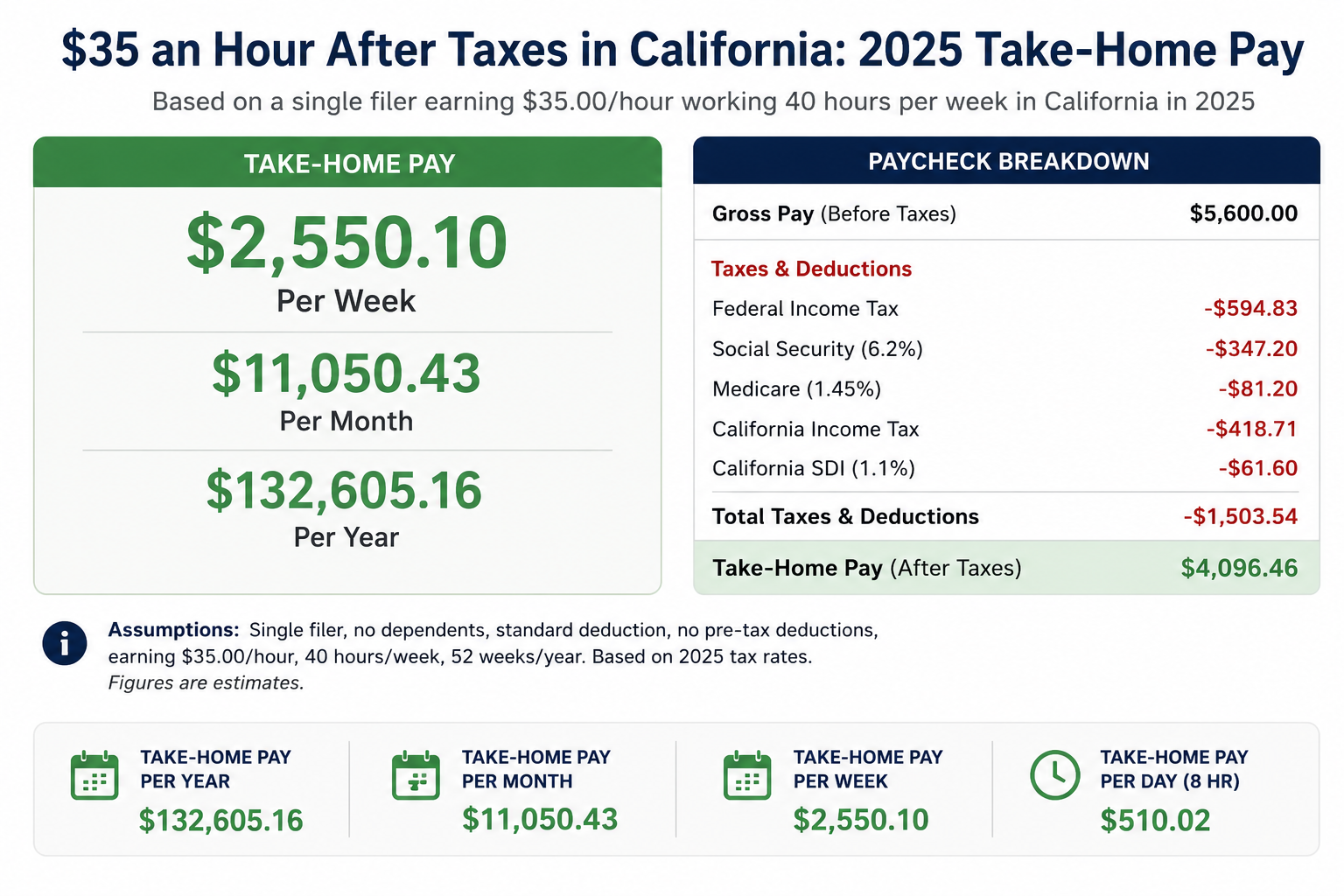
$35 an Hour After Taxes in California: 2025 Take-Home Pay
If you’re earning $35 an hour and living in California, you already know the state is expensive. But have you ever wondered what your true take‑home pay actually looks like after the taxman takes his share?
In this guide, we’ll break down exactly how much $35 an hour after taxes California residents can expect to earn in 2025. We’ll cover federal income tax, FICA, California’s unique SDI tax, state brackets, and show you exactly why your net pay might be lower than you think.
Let’s get into the numbers.
💰 California After‑Tax Salary Calculator
Estimate net take‑home pay for $35/hour – includes CA SDI and 2025 brackets
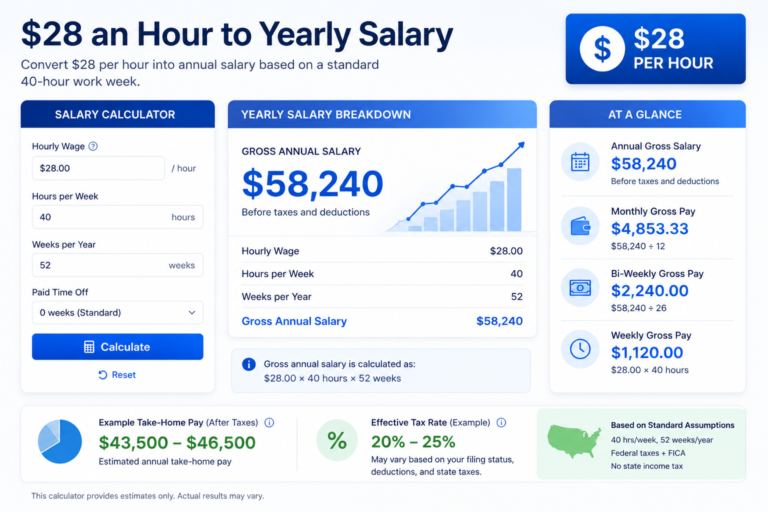
Gross Annual Pay at $35 Per Hour
First, the simple math. A full‑time employee works:
- 40 hours per week
- 52 weeks per year
Gross yearly salary = 35×40×52=∗∗72,800**
That’s your total income before any deductions. For perspective, that’s well above California’s minimum wage (16.50/hour)androughly∗∗8,000 higher than the MIT living wage estimate for a single adult in California ($28.72/hour)**.
But taxes and California’s special withholdings will eat into that amount. Let’s see by how much.
How Much Tax Will You Pay on $35 an Hour in California?
To answer the question “$35 an hour after taxes California,” you need to consider four main tax layers:
- Federal income tax (progressive brackets)
- FICA (Social Security + Medicare – 7.65% combined)
- California state income tax (progressive brackets)
- California SDI (State Disability Insurance – 1.2% of all wages)
We’ll use 2025 tax figures and assume a single filer with the standard deduction.
Step 1: Federal Income Tax
2025 federal brackets (single):
- 10% on 0–11,925 → $1,192.50
- 12% on 11,926–48,475 → $4,385.88
- 22% on 48,476–57,800 → $2,050.28
Total federal income tax = $7,628.66
Step 2: FICA (Social Security + Medicare)
- Social Security (6.2% of first 176,100in2025):72,800 × 6.2% = $4,513.60
- Medicare (1.45% of all wages): 72,800×1.451,055.60
Total FICA = $5,569.20
Step 3: California State Income Tax
California has a separate standard deduction and progressive brackets.
For a single filer in 2025:
2025 California brackets (single, partial):
- 1% on 0–11,079 → $110.79
- 2% on 11,080–26,264 → $303.70
- 4% on 26,265–41,452 → $607.48
- 6% on 41,453–57,542 → $965.34
- 8% on 57,543–67,094 → $764.08
Total California state income tax = $2,751.39
Note: the 9.3% bracket starts at $72,724, so this income stays in 8%.
Step 4: California SDI (State Disability Insurance)
California charges SDI tax on all wages (no cap) at a rate of 1.2% for 2025.
- SDI tax = 72,800×1.2873.60**
Total Tax & Net Annual Take‑Home (Single Filer)
| Deduction | Amount |
|---|---|
| Federal income tax | $7,628.66 |
| FICA (Social Security + Medicare) | $5,569.20 |
| CA state income tax | $2,751.39 |
| CA SDI | $873.60 |
| Total tax | $16,822.85 |
| Net annual take‑home | $55,977.15 |
That means your effective total tax rate is about 23.1%, and your net yearly income is roughly $55,977 for a single filer.
Real-World Example: Married Filing Jointly (Same $35/hour)
If you’re married and filing jointly, your tax burden drops significantly:
- Gross annual: $72,800
- Federal standard deduction (married joint, 2025): $30,000
- Taxable income: 42,800→federaltax=4,749 (12% bracket)
- FICA unchanged: $5,569
- CA standard deduction (married joint): $11,412
- CA taxable income: 61,388→CAstatetax≈1,681
- SDI unchanged: $874
**Net annual take‑home ≈ 59,927∗∗—over3,900 more per year than a single filer.
$35 an Hour After Taxes – Monthly & Weekly Breakdown (Single Filer)
| Period | Net Take‑Home |
|---|---|
| Yearly | $55,977 |
| Monthly | $4,665 |
| Semi‑monthly | $2,332 |
| Bi‑weekly | $2,153 |
| Weekly | $1,076 |
| Daily (8h) | $215 |
These are estimates for a single filer. Your exact paycheck may vary based on withholding, deductions, or pre‑tax benefits.
How $35/hour Compares to California’s Cost of Living
According to MIT’s Living Wage Calculator, a single adult with no children in California needs roughly $28.72/hour just to cover basic necessities like housing, food, and healthcare.
At 35/hour∗∗,you’reearningabout∗∗2235/hour∗∗,you’reearningabout∗∗22100,000 after taxes.
Benefits of Using a California‑Specific After‑Tax Calculator
- Avoids surprises – California has extra taxes (SDI) that many calculators miss.
- Compares jobs – a $35/hour offer in Texas vs. California is very different after taxes.
- Plans housing – know exactly how much rent you can afford.
- Optimizes withholding – adjust your W‑4 and DE‑4 to avoid owing money at tax time.
Step-by-Step: How to Calculate Your Own After‑Tax Pay in California
- Calculate gross annual – $35 × hours worked per week × weeks worked.
- Subtract federal standard deduction based on your filing status.
- Apply federal brackets to taxable income.
- Add FICA (7.65% of gross, up to Social Security cap).
- Subtract California standard deduction ( 5,706forsingle,11,412 for joint).
- Apply California brackets to CA taxable income.
- Add SDI (1.2% of all wages).
- Use the calculator below to skip the manual math.
Conclusion
So, 35anhouraftertaxesCalifornia∗∗residentscanexpecttotakehomeabout∗∗35anhouraftertaxesCalifornia∗∗residentscanexpecttotakehomeabout∗∗55,977 per year for a single filer in 2025. That’s roughly $4,665 per month.
While $35/hour is above the living wage, California’s unique combination of federal taxes, state income tax, and the 1.2% SDI tax means a significant portion of your gross income goes to taxes.
Knowing your true take‑home pay is the first step toward smart budgeting, housing decisions, and job negotiations.